
Key Takeaways
-
Existential OCD is highly treatable with Exposure and Response Prevention (ERP) therapy, which teaches you to tolerate uncertainty about unanswerable questions rather than seeking answers or reassurance.
-
Mental compulsions like reassurance-seeking, excessive research, and mental rituals actually strengthen OCD over time by reinforcing that existential thoughts are dangerous threats.
-
The key difference between healthy philosophical thinking and existential OCD is that OCD thoughts are intrusive, distressing, urgent, and severely disrupt daily life—whereas normal existential curiosity is reflective and manageable.
-
Existential OCD commonly affects teens, young adults, and people experiencing major life transitions by hijacking natural identity questions and turning them into persistent, anxiety-driven spirals.
-
Combining Exposure and Response Prevention with Cognitive Behavioral Therapy is more effective than either treatment alone, and medication can reduce anxiety intensity but requires therapy for lasting change.
-
Recovery from existential OCD happens through learning to live fully without needing definitive answers to unanswerable questions—a process that typically shows meaningful improvement within months of consistent therapy.
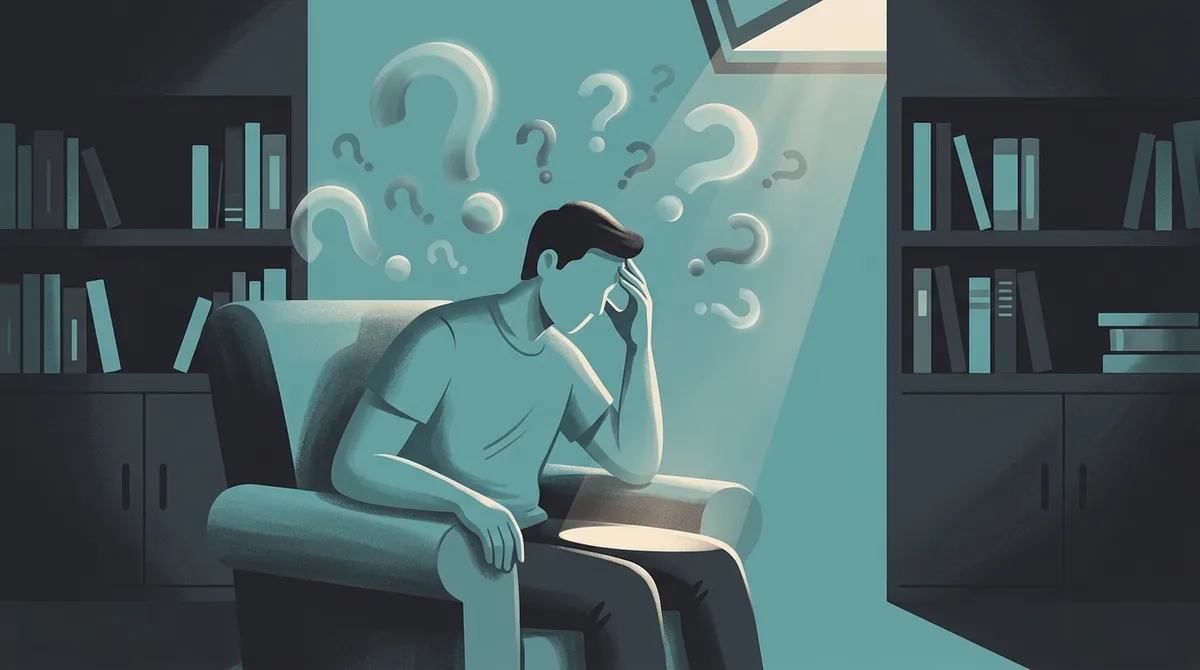
Have you ever found yourself stuck in an endless loop of deep, unanswerable questions? Things like, “Does my life have meaning?” or “What if reality isn’t real?” — thoughts that just won’t stop no matter how hard you try to push them away. If this sounds familiar, you might be experiencing existential OCD, and you’re definitely not alone.
Existential OCD is a subtype of obsessive-compulsive disorder. It’s sneaky because it disguises itself as deep philosophical thinking. But there’s a big difference between a passing curiosity about life’s mysteries and an intrusive, anxiety-driven spiral that disrupts your daily life. The good news? This condition is very treatable, and with the right support, you can find real relief. Let’s break it all down in a way that’s easy to understand.

What Is Existential OCD?
Existential OCD is when intrusive thoughts center on life’s biggest, most unanswerable questions. These aren’t just casual philosophical musings. They are persistent, distressing thoughts that feel impossible to shake. People with this condition often obsess over questions about existence, death, reality, and meaning — and the uncertainty causes intense anxiety and fear.
What sets existential OCD apart from regular anxiety treatment concerns is the nature of the obsession. General anxiety tends to focus on everyday fears like health, safety, or finances. Existential OCD digs deeper — into questions that literally have no definitive answer. And that’s exactly what makes it so exhausting.

Common Existential Obsessions
People dealing with existential OCD often find themselves stuck on questions like these:
- “What is the point of existing if everything eventually ends?”
- “How do I know my consciousness is real?”
- “What if there is no meaning to life at all?”
- “What happens after death — and how can I know for sure?”
- “What if I am not actually ‘me’ — just a simulation?”
- “What if the universe is infinite — what does that even mean?”
These thoughts aren’t dangerous on their own. But when OCD latches onto them, the brain treats them as urgent threats that demand an answer right now. And since these questions genuinely cannot be answered, the anxiety just keeps building.

Recognizing the Compulsions
OCD always involves two parts: obsessions and compulsions. With existential OCD, the compulsions are often mental rather than physical, which makes them harder to spot. Here are some common compulsive behaviors to watch for:
- Reassurance-seeking: Asking friends, family, or therapists repeatedly for comfort about existential fears.
- Excessive research: Spending hours online looking for philosophical answers or proof that life has meaning.
- Mental rituals: Replaying thoughts or arguments in your head trying to “solve” the existential problem.
- Taking OCD quizzes: Using online tests for temporary relief, only to feel anxious again soon after.
- Avoidance: Steering clear of topics, books, movies, or conversations that might trigger existential thoughts.
These compulsions might bring brief relief, but they actually make the OCD stronger over time. The brain learns that these thoughts are “dangerous” and responds with even more obsessing. If you’re experiencing panic attacks triggered by these spirals, know that help is available and things can get better.

How Existential OCD Affects Daily Life
Existential OCD isn’t just uncomfortable — it can seriously disrupt your daily routine. Here’s how it commonly shows up in everyday life:
- Work or school performance: It’s hard to focus when your brain is stuck in a philosophical spiral.
- Relationships: Constantly seeking reassurance can strain friendships and romantic partnerships.
- Sleep problems: Intrusive existential thoughts tend to get louder at night when distractions are gone.
- Emotional exhaustion: Trying to mentally “solve” unanswerable questions is draining.
- Feelings of detachment: Some people experience a sense of unreality or disconnection from their surroundings.
Left untreated, existential OCD can contribute to depression and a significant decline in overall mental health. The good news is that there are effective, evidence-based treatments that really work.
How Is Existential OCD Treated?
Here’s where things get hopeful! Existential OCD is very treatable. You don’t have to keep suffering through these cycles alone. Let’s look at the main treatment approaches.
Exposure and Response Prevention (ERP)
ERP is widely considered the gold standard treatment for all forms of OCD, including existential presentations. According to Mental Health Resources from the CDC, evidence-based treatment approaches like ERP are the most effective tools we have for OCD-related conditions.
Here’s how ERP works in simple terms:
- Exposure: You gradually face the existential thoughts that trigger your anxiety — instead of running from them.
- Response Prevention: You resist the urge to perform compulsions like reassurance-seeking or mental rituals.
- Tolerance building: Over time, your brain learns that the uncertainty is tolerable — and not dangerous.
ERP doesn’t try to answer existential questions. Instead, it teaches you to live comfortably with the fact that some questions simply don’t have answers — and that’s okay. A skilled psychotherapist can guide you through this process safely and at a pace that works for you.
Cognitive Behavioral Therapy (CBT)
CBT helps you identify and challenge the unhelpful thought patterns that fuel existential OCD. It teaches you to recognize when your brain is treating uncertainty as a threat — and how to respond differently. CBT is often used alongside ERP for the most effective results.
Medication
Medication can be a helpful part of treatment, especially if anxiety is very intense. Certain medications reduce the severity of obsessions, making it easier to engage in therapy. That said, medication alone doesn’t create lasting change — therapy is ultimately what helps you build the skills to manage existential OCD long-term. You can explore Substance Abuse & Mental Health resources in Florida for guidance on combined treatment options.
Existential OCD vs. Regular Existential Thinking
It’s worth clarifying the difference, because not every deep thought is a sign of OCD. Here’s a simple comparison:
| Feature | Healthy Existential Thinking | Existential OCD |
|---|---|---|
| Emotional tone | Curious, reflective, neutral | Anxious, distressing, urgent |
| Duration | Brief, passes naturally | Persistent, hard to stop |
| Response | Comfortable sitting with uncertainty | Compelled to seek answers or reassurance |
| Impact on life | Minimal interference | Disrupts work, relationships, sleep |
| Nature of thoughts | Welcome and interesting | Intrusive and unwanted |
If you recognize the OCD column in yourself, that’s a sign it may be time to reach out for professional support. You can also explore Mental Health Links from Florida Health for local resources and guidance.
Who Is Most Affected by Existential OCD?
Existential OCD can affect anyone, but some groups are especially vulnerable:
- Teenagers and young adults who are naturally grappling with identity and purpose — existential OCD can make these already-big questions feel terrifying rather than exciting.
- Millennials and Gen Z dealing with life transitions, academic stress, or isolation, where intrusive thoughts can spiral quickly.
- Adults experiencing major life changes like grief, relationship shifts, or career transitions, which can trigger existential questioning.
- People with a history of anxiety or other OCD subtypes, as the conditions often overlap.
If you’re a parent noticing your teen struggling with these kinds of intrusive, anxious thoughts, it’s worth looking into in-person therapy in Brandon, Florida as a starting point for assessment and support.
How West Florida Therapy Can Help
At West Florida Therapy, Margaret Deuerlein is a caring, licensed psychotherapist who understands how isolating and exhausting existential OCD can feel. Whether you’re a young adult navigating a mental health crisis, a teenager feeling overwhelmed by intrusive thoughts, or an adult who has been quietly struggling for years — Margaret is here to help.
West Florida Therapy offers both in-person sessions in Brandon, Florida and telehealth therapy across all of Florida. Bilingual services in English and Spanish are also available, making support more accessible for Spanish-speaking adults and families. You can even start with a free 15-minute phone consultation to see if it’s the right fit — no pressure, no commitment.
If you’re curious about how the journey begins, you can learn more about our process so you know exactly what to expect from the very first session. You can also visit us on Google to read reviews from real clients who have found relief and hope through therapy.
Steps to Take If You Think You Have Existential OCD
Not sure where to begin? Here’s a simple roadmap:
- Acknowledge what you’re experiencing. Recognizing the pattern of obsessions and compulsions is the first step toward healing.
- Reach out to a mental health professional. Look for someone trained in OCD and ERP therapy specifically.
- Be honest about your symptoms. The more your therapist knows, the better they can tailor your treatment plan.
- Commit to the process. ERP takes courage, but the rewards — a calmer, more free mind — are absolutely worth it.
- Be patient with yourself. Recovery is possible and it does happen, one session at a time.
You might also find it helpful to explore related topics like understanding anxiety signs, types, and treatment options as you learn more about what you’re experiencing. Existential OCD often overlaps with mood issues and can even affect close relationships, so looking into relationship challenges may also be worthwhile if your connections have been strained.
You Deserve to Feel Free from These Thoughts
Existential OCD can make you feel like you’re trapped inside your own mind, endlessly searching for answers that don’t exist. But here’s the truth: recovery isn’t about finding those answers. It’s about learning to live fully and joyfully even without them. And that is absolutely possible.
You don’t have to figure this out alone. Whether you’re exploring therapy for the first time or you’ve tried other approaches without success, reaching out is always the right move. Margaret Deuerlein at West Florida Therapy is ready to walk alongside you on this journey — with warmth, expertise, and genuine care.
Take that first step toward a calmer, freer mind by reaching out to our team today. A free 15-minute consultation is all it takes to start moving forward.
FAQs
Q: What is the difference between existential OCD and regular existential anxiety?
A: Great question! Regular existential thinking is curious and relatively comfortable — you can sit with the uncertainty and move on. Existential OCD, on the other hand, involves intrusive, distressing thoughts that feel urgent and impossible to stop, paired with compulsive behaviors like reassurance-seeking or excessive research to find relief.
Q: Can existential OCD be treated without medication?
A: Yes, absolutely! Many people find lasting relief through therapy alone, particularly Exposure and Response Prevention (ERP) and Cognitive Behavioral Therapy (CBT). Medication can be helpful for reducing the intensity of anxiety, but therapy is what builds the lasting skills you need to manage existential OCD long-term.
Q: How long does treatment for existential OCD typically take?
A: Treatment timelines vary from person to person, but many people begin to notice meaningful improvement within a few months of consistent therapy. Your therapist will regularly check your progress and adjust your plan as needed so you keep moving forward at a pace that works for you.
Q: Is virtual therapy available for existential OCD in Florida?
A: Yes! Telehealth therapy is a convenient and effective option for treating existential OCD. West Florida Therapy offers virtual sessions for clients throughout all of Florida, so you can get the support you need from the comfort of your own home — no commute required!
Q: What should I do if I think I have existential OCD?
A: The best first step is to reach out to a mental health professional who has experience treating OCD. You don’t have to have all the answers before you make that call! A brief consultation — like the free 15-minute phone consultation offered at West Florida Therapy — can help you figure out the right path forward.