

Key Takeaways
-
Verify therapist credentials through Florida's Department of Health Mental Health Links resource; only licensed LMFTs, LMHCs, LCSWs, or psychologists are qualified to provide divorce counseling.
-
Individual therapy is typically the right choice for processing personal grief and anger, while couples therapy should only occur when both partners are willing and there's no history of abuse, domestic violence, or coercive control.
-
Co-parenting counseling focuses specifically on parenting communication and scheduling post-divorce, not on repairing the romantic relationship, and can prevent escalating arguments about children.
-
Therapy notes are generally not used as evidence in custody disputes; coordinate your therapist with a family law attorney to manage emotional support separately from legal proceedings.
-
Brandon-area therapists typically charge around $120 per session; verify your insurance mental health benefits directly with your provider before appointments, and ask about telehealth options during your consultation call.
-
Call 988 (Suicide & Crisis Lifeline) or go to an emergency room immediately if you experience thoughts of self-harm; routine counseling cannot replace emergency crisis care.
Going through a divorce can feel like your whole world has been turned upside down. One day you had a plan for your life, and the next, everything feels uncertain. If you are searching for divorce therapy in Brandon, Florida, please know this: you are not alone, and you do not have to figure this out by yourself. Many caring, licensed professionals in our community are ready to walk beside you through this hard season.
Divorce therapy is simply a form of counseling that helps you process the emotional, mental, and sometimes practical challenges that come with separation and divorce. It can support you whether you are the one who wants the divorce, the one who did not see it coming, or somewhere in between. At West Florida Therapy, our founder, Margaret Deuerlein, brings warmth and genuine care to every session, helping clients throughout Brandon find their footing again. Let’s talk about what divorce therapy really looks like and how to find the right fit for you.

What Is Divorce Therapy, Exactly?
Divorce therapy is not one single thing. It can look different depending on your situation and what you need most right now. Generally, it refers to individual, couples, family, or co-parenting counseling that helps people manage the emotional fallout of separation.
This kind of therapy can happen before a divorce is finalized, during the process, or long after the papers are signed. Grief does not follow a strict timeline, and neither does healing. A good therapist meets you exactly where you are.
Common Goals of Divorce Therapy
People come to divorce therapy for many different reasons. Here are some of the most common goals clients work toward:
- Reducing feelings of anxiety, sadness, or hopelessness
- Processing anger, grief, or guilt tied to the relationship ending
- Learning how to communicate more calmly with an ex-partner
- Setting healthy boundaries during a difficult transition
- Building practical co-parenting strategies that protect children
- Rebuilding self-esteem and a sense of identity after divorce
If any of these resonate with you, therapy focused on mood issues or depression treatment may also be a helpful part of your healing journey, especially if sadness has settled in deeply.
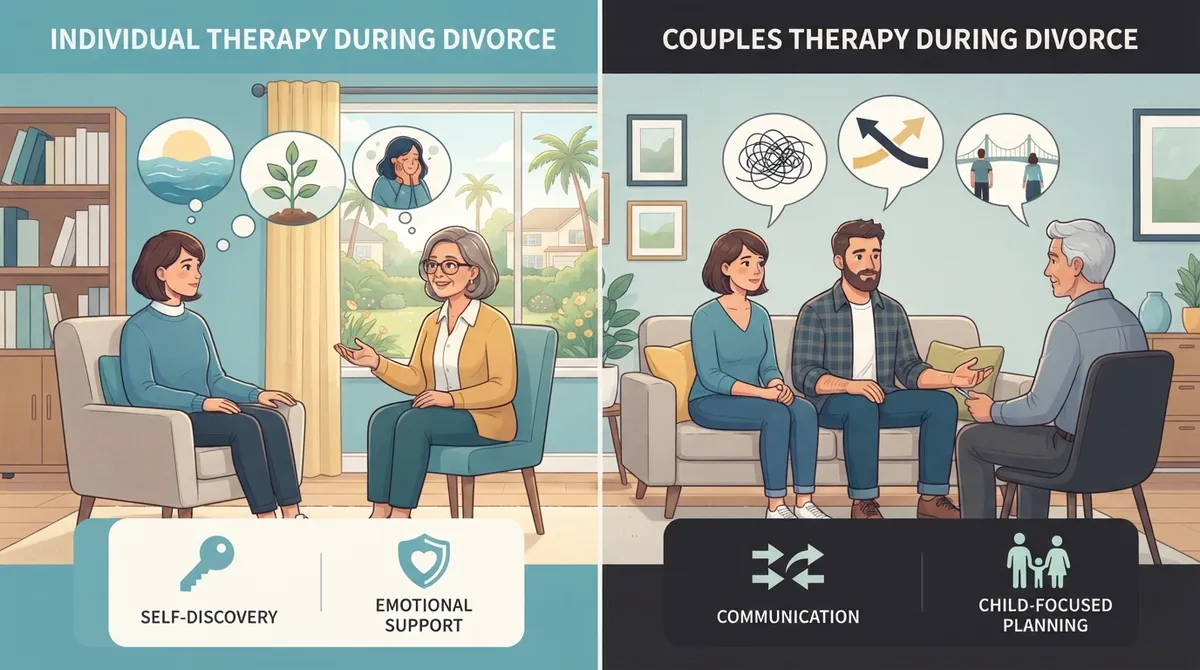
Individual Therapy vs. Couples Therapy During Divorce
One question we hear often is whether someone should attend individual sessions or bring their partner along. The honest answer is, it depends on your specific situation.
When Individual Therapy Makes Sense
Individual therapy is often the right starting point when you are processing your own grief, anger, or fear. It gives you a private space to talk honestly without worrying about your ex-partner’s feelings or reactions. Many people find that anxiety treatment paired with divorce support helps them feel steadier during an unpredictable time.
When Couples Therapy Might Help
Sometimes couples come to therapy together, even during separation, to work through practical issues like co-parenting or to find closure in a respectful way. Couples therapy can support this kind of structured, guided conversation when both partners are willing and it is safe to do so.
An Important Safety Note
Joint sessions are not appropriate in every case. If there has been domestic violence, coercive control, threats, or stalking, couples counseling can actually be unsafe. A responsible therapist will always screen for these concerns before recommending joint sessions. Your safety always comes first, no exceptions.
| Situation | Recommended Approach |
|---|---|
| Processing personal grief or anger | Individual therapy |
| Co-parenting communication struggles | Structured joint sessions or family therapy |
| History of abuse or coercive control | Individual therapy only, with safety planning |
| Teen struggling with the divorce | Adolescent-focused therapy |
| High-conflict custody disagreements | Co-parenting counseling, possibly with a parenting coordinator |
How to Find a Licensed Divorce Therapist Near Brandon, FL
Not everyone who calls themselves a “counselor” holds a valid Florida license, so it is worth doing a little homework. Here is a simple step-by-step approach:
- Look for the right credentials. Florida-licensed marriage and family therapists (LMFTs), licensed mental health counselors (LMHCs), licensed clinical social workers (LCSWs), and psychologists are all qualified to provide divorce-related counseling.
- Verify the license. You can check any therapist’s license status through Florida’s official Mental Health Links resource page from the Department of Health.
- Ask about their experience. Some therapists specialize in family systems, grief, or high-conflict separations. It is okay to ask directly about their background.
- Consider location and format. Decide if you want in-person sessions in Brandon or prefer telehealth therapy from home.
- Schedule a consultation call. Many practices, including ours, offer a short phone conversation so you can ask questions before committing.
Florida law requires LMFTs to complete rigorous training, including at least 400 hours of supervised clinical practicum and two years of post-master’s supervised experience before they can practice independently. This means the therapist sitting across from you has invested years preparing to help people just like you.
What Approaches Do Divorce Therapists Use?
Every therapist has their own style, but most divorce counseling draws from a handful of proven approaches. Here is a quick breakdown:
- Cognitive behavioral therapy (CBT): Helps you notice and reshape unhelpful thought patterns tied to fear or self-blame.
- Emotionally focused therapy: Useful for exploring attachment wounds, even after a relationship has ended.
- Family systems therapy: Looks at how the whole family, including kids, is adjusting to the change.
- Solution-focused therapy: Concentrates on practical next steps rather than dwelling only on the past.
- Trauma-informed care: Essential when the marriage involved abuse or significant emotional harm.
If your divorce has stirred up old wounds, trauma therapy or EMDR treatment might be recommended alongside your regular sessions.
Helping Kids and Teens Through Divorce
Divorce affects the whole family, and children often need their own space to process the changes happening around them. Teenagers, in particular, may struggle silently while trying to appear fine for their parents.
Signs your teen might benefit from support include withdrawing from friends, slipping grades, irritability, or trouble sleeping. A therapist trained in adolescent care can offer a safe outlet for these big feelings, separate from mom and dad’s conflict. This kind of support fits well within a broader focus on mental health for the entire family unit.
What About Co-Parenting Counseling?
Co-parenting after divorce is one of the hardest ongoing challenges families face. A skilled therapist can help you and your former partner develop a workable plan for communication, scheduling, and decision-making, even when trust has been damaged.
This is different from marriage counseling. Co-parenting counseling focuses purely on how you function as parents moving forward, not on repairing the romantic relationship. It can be especially helpful when disagreements about parenting keep escalating into arguments.
A Few Things to Know About the Legal Side
It is important to understand that therapists provide emotional support and coping strategies, not legal advice. A divorce therapist cannot represent you in court or replace a family law attorney. In most cases, therapy notes and sessions are not intended to serve as evidence in custody disputes, and therapists generally avoid becoming involved in legal proceedings whenever possible.
If your situation involves custody battles or legal disputes, coordinating your therapist with a Florida family law attorney or mediator often works best. Your therapist can help you manage stress and emotions while the legal professionals handle the paperwork and negotiations.
What Does Divorce Therapy Cost in Brandon, Florida?
Pricing varies from provider to provider, so it is always smart to ask directly. Some Brandon-area counselors post standard rates around $120 per session for licensed clinicians like LMHCs, LCSWs, or LMFTs, though this can differ based on experience, session length, and format.
Insurance and Payment Options
Many practices accept a mix of insurance and self-pay options. At West Florida Therapy, we work with several major providers, including Aetna, Cigna, Florida Blue, Optum, Oscar, and United Health Care. We also welcome clients who prefer to pay out-of-pocket for added privacy and flexibility, and we accept HSA and FSA accounts too.
Before your first appointment, it is worth calling your insurance company to confirm your mental health benefits, copays, and deductible details. Coverage rules can vary quite a bit, even between plans from the same company.
Questions to Ask Before Your First Session
Choosing a therapist is a personal decision, and it helps to feel prepared. Consider asking these questions when you first reach out:
- Are you licensed in the state of Florida, and what is your license type?
- Do you have experience working with divorce or separation specifically?
- Do you offer telehealth sessions if I cannot always come in person?
- How do you handle situations involving safety concerns or past abuse?
- What is your fee, and do you accept my insurance?
- Do you offer bilingual services in English and Spanish?
Speaking of bilingual care, many Spanish-speaking families in the Brandon area have told us how much of a relief it is to finally find a therapist who understands their language and culture without needing a translator. That comfort matters deeply when you are opening up about something as personal as divorce.
When to Seek Help Right Away
Divorce can bring up intense emotions, and sometimes those feelings become overwhelming. If you or someone you love is having thoughts of self-harm, please do not wait for a scheduled appointment. Call 911, go to your nearest emergency room, or call or text 988 to reach the Suicide & Crisis Lifeline immediately.
Routine counseling is incredibly valuable, but it is not designed to replace emergency care during a crisis. Organizations like the Mental Health Resources page from the CDC and Florida’s own Substance Abuse & Mental Health services can also point you toward additional support when you need it most.
Why Local, Bilingual Support Matters
Living in the Brandon area means you deserve care that understands your community. Whether you need in-person sessions close to home or prefer connecting through virtual therapy anywhere in Florida, having options makes a real difference during such an unpredictable time.
At West Florida Therapy, Margaret Deuerlein and her team believe healing should feel personal, not clinical or cold. Every client’s story matters, and every treatment plan is built around real goals, not a one-size-fits-all script. You can learn more about how sessions typically unfold on our our process page, or explore relationship problems resources if communication struggles are part of your story too.
Curious what other clients have experienced? Feel free to visit us on Google — West Florida Therapy to read real reviews from people who have walked this path before you.
Taking the First Step Toward Healing
Divorce is rarely simple, and healing does not happen overnight. But with the right support, you can move through this chapter with more clarity, less fear, and a stronger sense of who you are becoming. You deserve a therapist who listens without judgment and helps you build real, practical tools for moving forward.
If you are ready to talk to someone who genuinely cares about your story, we would love to hear from you. Reach out to our team today to schedule your free 15-minute consultation and take that first brave step toward feeling like yourself again.
FAQs
Q: How can divorce therapy help someone in Brandon, Florida?
A: Divorce therapy gives you a safe space to process grief, anger, and fear while learning practical tools for moving forward. It can also help with co-parenting communication and rebuilding your sense of self. Many people find that having a caring guide, like the team at West Florida Therapy, makes this hard season feel a little lighter.
Q: Should I attend individual therapy or couples therapy during a divorce?
A: It really depends on your situation and what feels safe for you. Individual therapy is often a great starting point for processing personal emotions, while couples sessions can help with co-parenting when both partners are willing and there are no safety concerns.
Q: Does insurance cover divorce counseling in Florida?
A: Many insurance plans do cover mental health counseling, including sessions related to divorce and separation. It is always best to call your insurance provider directly to confirm your specific benefits, copays, and deductible requirements before your first appointment.
Q: Can a divorce therapist testify in a Florida custody case?
A: Generally, therapists focus on emotional support and coping strategies rather than legal matters, and most try to stay separate from courtroom proceedings. If you have legal or custody concerns, it is best to work closely with a Florida family law attorney alongside your therapist.
Q: What should I ask a therapist before scheduling a divorce counseling appointment?
A: Great questions to ask include whether they are licensed in Florida, if they have experience with divorce or separation, and whether they offer telehealth or bilingual services. Do not be afraid to ask about fees and insurance too, it is completely normal and expected.