Key Takeaways
-
DBT teaches practical emotion regulation skills through a toolbox approach, with naming emotions and checking the facts being foundational techniques that reduce impulsive reactions and protect relationships.
-
Research shows DBT delivered in 12-16 sessions produces lasting benefits for 12-24 months, with adolescents reporting improved emotional regulation that persists at the 3-month mark.
-
Opposite action is a powerful DBT technique where you deliberately act opposite to what an intense emotion tells you to do, effectively breaking cycles of avoidance and isolation.
-
Physical wellness directly impacts emotional regulation; the PLEASE skills (treating illness, eating, avoiding substances, sleeping, exercising) create a stronger foundation for managing intense feelings.
-
DBT-informed therapy is available in Brandon through West Florida Therapy with in-person and telehealth options, plus bilingual services for Spanish-speaking families seeking emotional regulation support.
-
DBT works best for people with intense, rapid-cycling emotions and is more effective than standard CBT when emotions feel too big to manage through thought work alone.
Do you ever feel like your emotions go from zero to one hundred in seconds? One minute you’re fine, and the next you’re crying, yelling, or shutting down completely. If this sounds familiar, you are not broken, and you are not alone. Many people in Brandon feel this way every single day. The good news is that Dialectical Behavior Therapy, or DBT, offers real, practical tools that help calm the storm. This article walks you through 14 powerful DBT skills and facts that can help you get your emotions back in the driver’s seat.
Whether you’re a busy parent, a stressed-out young adult, or a teenager struggling with big feelings, this guide is for you. Margaret Deuerlein and the team at West Florida Therapy have helped countless people in Brandon build skills for lasting emotional balance. Let’s dive into what makes DBT for emotional regulation so effective, and how you can start using it today.

1. Understand What DBT for Emotional Regulation Really Means
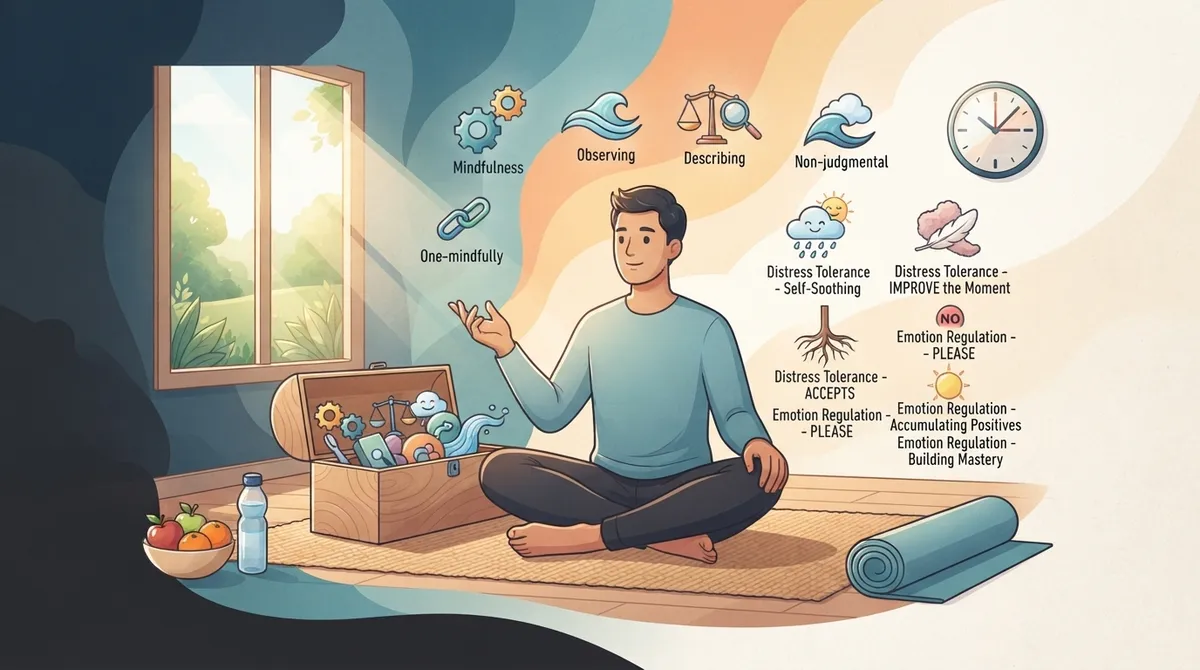
DBT is a structured, skills-based therapy. It teaches you practical strategies for managing intense emotions, rather than just talking about your feelings for an hour. Think of it like a toolbox. Each tool has a specific job, and you learn exactly when and how to use it.
Emotional regulation is one of DBT’s four core skill areas. The others are mindfulness, distress tolerance, and interpersonal effectiveness. Together, these skills give you a full system for handling life’s hardest moments. If you want to learn more about how mood issues connect to daily struggles, our page on mood issues breaks this down further.
2. Know Where DBT Came From
DBT was first created to help people with borderline personality disorder. Over time, therapists found it also helps many other conditions. Today, it is used for depression, anxiety, bipolar disorder, trauma, and impulsive behavior.
This matters because it means DBT is not just for one type of person. If your emotions feel too big, too fast, or too hard to control, DBT skills were likely designed with you in mind.
3. Learn Why Emotion Regulation Is a Core DBT Skill
One of the biggest goals of DBT is helping you recognize, understand, label, and manage your emotions more effectively. This sounds simple, but it is actually a game changer. Most of us were never taught how to name what we feel, let alone what to do about it.
When you learn to label an emotion correctly, you reduce the chance of acting on it in ways you later regret. This skill alone can protect your relationships, your job, and your peace of mind.
4. See the Research Behind DBT’s Success
The numbers behind DBT are encouraging. One review found that DBT delivered in just 12 to 16 sessions produced positive outcomes for non-clinical populations. These benefits lasted between 12 and 24 months.
In a separate study, adolescents reported better emotional regulation right after treatment. Even three months later, those improvements were still present. That same study found a large drop in fear of emotions after treatment, and while it became more modest over time, it did not disappear.
Quick Stats Snapshot
| Finding | Result |
|---|---|
| Non-clinical DBT (12-16 sessions) | Benefits lasted 12-24 months |
| Adolescent emotion regulation | Improved right after treatment, held at 3 months |
| Fear of emotion in teens | Large decrease, modestly maintained at 3 months |
| DBT for borderline personality disorder | Evidence-based for severe, chronic cases |
5. Recognize the Four Modules of DBT
DBT is built around four main skill sets. Knowing these helps you understand how the whole system fits together.
- Mindfulness: staying present instead of stuck in the past or worried about the future
- Distress tolerance: getting through painful moments without making things worse
- Emotion regulation: understanding and managing intense feelings
- Interpersonal effectiveness: communicating needs while keeping relationships healthy
Each module supports the others. You cannot fully regulate your emotions without also practicing mindfulness and tolerating distress along the way.
6. Learn the Skill of Naming Your Emotions
Before you can manage a feeling, you have to know what it is. DBT teaches clients to pause and ask, “What am I actually feeling right now?” This sounds basic, but many people confuse anger with hurt, or anxiety with excitement.
Practicing this skill daily builds a habit. Over time, naming emotions becomes automatic instead of something you have to force.
7. Practice Checking the Facts
Sometimes our emotions come from a story we tell ourselves, not what actually happened. DBT teaches a skill called “check the facts.” You look at the situation and ask if your emotional reaction actually fits what happened.
This does not mean your feelings are wrong. It means you get a chance to respond based on reality, not just fear or assumption. This is especially helpful for people dealing with anxiety that spirals quickly.
8. Use Opposite Action When Emotions Don’t Fit
This is one of the most powerful DBT tools. When an emotion does not match the facts, or acting on it would make things worse, you do the opposite of what the emotion tells you to do.
For example, if fear tells you to avoid a friend after a small disagreement, opposite action means reaching out instead. This skill takes practice, but it can break cycles of isolation and avoidance quickly.
9. Build Your PLEASE Skills for Physical Wellness
DBT recognizes that your body affects your mood just as much as your thoughts do. The PLEASE skills remind you to:
- Treat Physical iLlness
- Balance Eating
- Avoid mood-altering substances
- Balance Sleep
- Get Exercise
Skipping meals, losing sleep, or skipping movement can make your emotions harder to manage. Small physical habits create a stronger foundation for emotional stability.
10. Reduce Vulnerability with Daily Habits
Beyond PLEASE, DBT teaches you to notice patterns that make you emotionally vulnerable. Are you always more irritable when you’re hungry? Do you snap at loved ones after a bad night’s sleep?
Tracking these patterns helps you plan ahead. If you know Monday mornings are hard, you can build in extra self-care the night before.
11. Know Who Benefits Most from DBT
DBT was built for people who feel emotions intensely. It works well for:
- Adults dealing with mood swings, anxiety, or depression
- Teens struggling with school pressure or family conflict
- People recovering from trauma or difficult relationships
- Couples working through communication breakdowns
- Anyone who feels overwhelmed by their own reactions
You do not need to be in crisis to benefit from these skills. Many people start DBT-informed work as a way to build coping tools before things feel unmanageable. If trauma is part of your story, our page on trauma therapy may also be helpful.
12. Compare DBT and CBT
People often ask about the difference between DBT and standard cognitive behavioral therapy. Here is a simple breakdown.
| Feature | CBT | DBT |
|---|---|---|
| Main Focus | Changing unhelpful thoughts | Managing intense emotions and behaviors |
| Skills Taught | Thought challenging, problem solving | Mindfulness, distress tolerance, emotion regulation, relationship skills |
| Best For | Anxiety, depression, general negative thinking | Emotional intensity, impulsivity, relationship struggles |
| Format | Usually individual sessions | Often includes individual work and group skills training |
Both approaches share roots in cognitive behavioral therapy, but DBT adds specific tools for people whose emotions feel too big to manage with thought work alone.
13. Start Small with a Step-by-Step Approach
Getting started with DBT skills does not have to feel overwhelming. Here is a simple sequence many clients follow.
- Notice and name the emotion you’re feeling right now
- Rate its intensity on a scale from one to ten
- Check the facts of the situation causing the feeling
- Choose one skill, like opposite action or a PLEASE habit, to try
- Reflect afterward on what worked and what didn’t
- Practice the same skill again in a lower-stakes moment
- Bring your experience to your therapist for feedback and adjustment
Comprehensive DBT programs often include weekly individual therapy, a skills group, diary cards to track emotions, and sometimes phone coaching between sessions. You do not have to figure this out alone, and our therapy process is designed to guide you every step of the way.
14. Access DBT-Informed Support Right Here in Brandon
You do not have to drive across the state to find quality care. West Florida Therapy offers in-person sessions in Brandon, along with telehealth therapy available throughout Florida. This means whether you prefer face-to-face sessions or the comfort of your own home, support is within reach.
Margaret Deuerlein brings warmth, patience, and real clinical skill to every session. She understands that opening up is hard, and she creates a space where clients feel safe to do the work. You can learn more about her approach on our About Margaret Deuerlein page.
For Spanish-speaking families in the Brandon area, bilingual services remove a huge barrier to getting help. Emotional pain does not care what language you speak, and neither do we. Our team wants every client, regardless of background, to feel truly understood.
Signs You Might Benefit from Emotional Regulation Support
Not sure if this is the right step for you? Here are some common signs that DBT-informed therapy could help.
- You feel emotions much more intensely than people around you
- Small stressors trigger big reactions you regret later
- You struggle to calm down once upset
- Relationships feel strained by frequent conflict or misunderstandings
- You avoid situations because you fear losing control of your emotions
- You’ve tried other approaches without lasting relief
If several of these sound familiar, it might be time to explore depression treatment or emotion-focused support tailored to your needs.
Support for Every Stage of Life
Emotional regulation challenges show up differently depending on your age and situation. Teenagers may struggle with school pressure and social anxiety. Young adults often face job stress and life transitions. Couples may find that unmanaged emotions fuel repeated arguments.
West Florida Therapy works with individuals, adolescents, and couples. If relationship conflict is part of the picture, our couples therapy services can help both partners learn to regulate emotions together, not just individually.
Local families often look for trustworthy resources beyond therapy too. Just as you might trust Smile District for dental care or Panther Pools for pool maintenance in the area, we hope Brandon residents will trust West Florida Therapy for their emotional wellness needs.
For additional statewide resources, the Florida Department of Health’s mental health links page offers helpful information. The Florida Department of Children and Families also provides guidance on mental health and substance abuse services. And for general wellness tips, the CDC’s mental health resources page is a solid, trustworthy starting point.
Bringing It All Together
Learning to regulate your emotions is not about becoming a robot who never feels anything. It’s about building a life where your feelings inform you instead of controlling you. DBT gives you real, usable tools to get there, one skill at a time.
You deserve support that meets you where you are, whether that’s managing daily stress, healing from trauma, or improving how you connect with people you love. West Florida Therapy is proud to serve the Brandon community with care that is compassionate, practical, and genuinely effective. Feel free to check out what our West Florida Therapy clients say by visiting our Google Business Profile.
Ready to take the first step toward steadier emotions and a calmer mind? Reach out to our team today to schedule your free 15-minute consultation and see how DBT-informed therapy can work for you.
FAQs
Q: What is DBT for emotional regulation?
A: DBT for emotional regulation is a skills-based approach that teaches you practical ways to understand, name, and manage intense feelings. Instead of just talking about emotions, you actually practice tools like opposite action and checking the facts. It’s like learning a new language for your feelings, one that finally makes sense.
Q: How does DBT help with emotional regulation?
A: DBT helps by breaking down big, overwhelming emotions into smaller, manageable steps. You learn to notice what you’re feeling, question whether it fits the situation, and choose a helpful response instead of an automatic reaction. Over time, this builds confidence and calm, even in tough moments.
Q: Is DBT effective for anxiety or depression?
A: Yes, many people with anxiety or depression benefit from DBT skills, even though DBT was originally developed for other conditions. The emotion regulation and distress tolerance tools are especially helpful for calming anxious spirals and lifting the heaviness of depression. It’s a flexible approach that adapts to many struggles.
Q: How long does DBT take to work?
A: Some studies show positive changes after just 12 to 16 sessions, with benefits lasting a year or more. Everyone’s timeline looks a little different, though, since it depends on your goals and how consistently you practice the skills. The good news is that many people notice small shifts within just a few weeks.
Q: Is DBT available in Brandon, Florida?
A: Absolutely! West Florida Therapy offers DBT-informed support right in Brandon, with both in-person and virtual sessions available across Florida. Margaret Deuerlein and our team are here to walk alongside you, whether you prefer meeting face-to-face or from the comfort of home.